

Can your Shopify store sell on ChatGPT? A practical UCP guide
Eligibility is narrower than the announcement, especially for Indian stores. What UCP changes and the catalogue and checkout checks worth making first.

Published 7 min readSources
In this article9 sections
- The answer for an Indian Shopify merchant
- UCP, agentic storefronts and MCP do different jobs
- Inspect the catalogue before buying an AI app
- Keep inventory and showroom sales consistent
- Check the checkout your customer will actually use
- Measure orders, and be honest about attribution
- What developers need to update from older MCP guides
- What we would do next
- Sources
A shopper asks an AI assistant for a cotton shirt within a budget that can arrive before a wedding. Your store sells one. Does the assistant know the fabric, the right size, the stock level and the delivery conditions well enough to recommend it?
That is a more useful starting question than whether your shop is "AI ready". A recommendation becomes a sale only when those details survive the journey to checkout.
Shopify and Google announced the Universal Commerce Protocol on 11 January 2026. UCP gives commerce systems and AI agents a shared way to describe shopping operations, and Shopify's agentic storefronts connect eligible products to AI shopping channels. The announcement was broad. The current eligibility rules are narrower, especially for Indian merchants.
The answer for an Indian Shopify merchant#
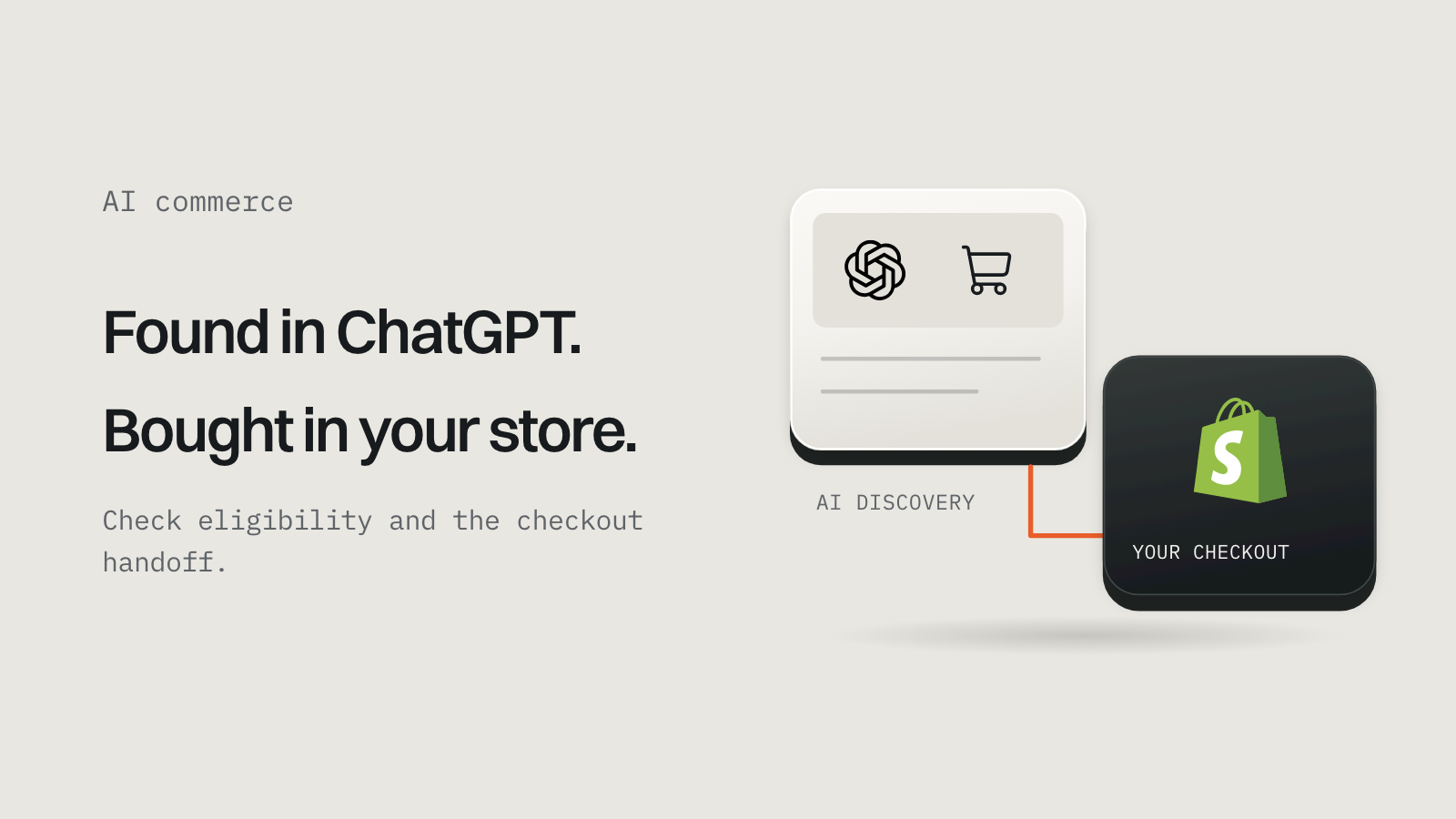
As checked on 4 October 2026, Shopify's ChatGPT eligibility page allows stores based outside the US. It requires US customers, eligible catalogue products, accepted channel terms and completed store policies. ChatGPT helps customers discover products and sends them to your online store checkout; there is no separate direct-checkout switch for this channel.
Google AI Mode and Gemini direct checkout has a different rule. Shopify says the store must be based in the US and sell to US customers, and the feature is still rolling out. A working Google product feed doesn't grant an India-based store access to this checkout.
| Shopping path | What Shopify documents | What to check |
|---|---|---|
| ChatGPT product discovery | Eligible stores selling to US customers; the seller may be outside the US | Catalogue eligibility, channel terms and policies |
| Purchase after ChatGPT discovery | Your existing online store checkout | Shipping, payment methods and checkout customisations |
| Google AI Mode and Gemini direct checkout | US-based stores selling to US customers, subject to rollout | Store location, Merchant Center and actual access in Admin |
| Google product discovery | Products supplied through Merchant Center | Feed status and Google's requirements for your market |
If all your orders ship within India, treat this as a reason to improve product information and watch availability. It isn't evidence that the ChatGPT merchant channel already serves your domestic customers.
UCP, agentic storefronts and MCP do different jobs#
- UCP is an open commerce protocol. Its specification describes capabilities a merchant and an agent can negotiate, plus transports, identity and payment responsibilities.
- Agentic storefronts are Shopify's merchant-facing channel controls.
- MCP, the Model Context Protocol, is one way software exposes tools to an AI assistant.
Supporting the protocol doesn't mean every shopping app supports every capability; a protocol can describe an operation before a channel offers it to a particular merchant.
Shopify's catalogue developer documentation distinguishes a Global Catalog across merchants from a Storefront Catalog scoped to one store, both implementing UCP catalogue capabilities. That matters if you're building an assistant. It doesn't mean an ordinary merchant needs a custom MCP server to join Shopify's existing channels.
My view is that a merchant's first budget should go to accurate product data and a working order process. Commission a custom assistant when you can name a customer task the existing channels don't handle, such as confirming a delivery restriction or discussing a made-to-order finish. A chat interface can't make an unsupported checkout requirement disappear.
Inspect the catalogue before buying an AI app#
Shopify's Catalog requirements include product titles, at least one image, a positive price, identifiable product URLs and publication to supported channels. Store policy standing and account history also count, and a private store or a product hidden from search may fail inclusion.
Meeting those requirements gets a product considered. It doesn't mean a shopper understands it. Pick a sample: a bestseller, a product with variants, a sale item and something that causes support questions. Read each listing as if the photographs were missing.
| Product detail | Weak listing | More useful listing |
|---|---|---|
| Material | "Premium fabric" | The verified fibre composition |
| Size | A size name without measurements | Measurements and how to choose |
| Intended use | "Perfect for every occasion" | Specific uses the product supports |
| Delivery | "Fast shipping" | Destinations, dispatch conditions and stated delivery estimates |
| Variants | Colour names that don't match the images | Matching names, images and variant identifiers |
| Returns | A reassurance without terms | A policy explaining eligibility and exclusions |
These are editorial recommendations, not a disclosed ranking formula. They help a customer and an assistant answer the same purchase questions.
Suppose the shirt is a cotton blend. Calling it "pure cotton" may put it in an unsuitable comparison. Fix the claim in the catalogue itself; a separate AI description that contradicts the product page is one more version to maintain. Where key details live in metafields or metaobjects, Shopify Catalog Mapping can source the right fields. Review the mapped output.
Keep inventory and showroom sales consistent#
A recommendation built on stale stock causes the same problem as a search ad for an unavailable product. An extra channel makes the existing inventory problem more visible.
Picture a retailer with one item left. A showroom salesperson sells it while the online catalogue still shows it as available, and another buyer reaches checkout through an AI recommendation. Which system owns the stock count, and when does the showroom sale update it?
Write that answer down before adding acquisition channels, including reserved stock, cancellations, refunds and returns to saleable inventory. If your team tracks customers and offline balances in a spreadsheet, our Shopify CRM guide covers that gap. Extra traffic is expensive when staff correct each order by hand.
Check the checkout your customer will actually use#
ChatGPT referrals use the merchant's own checkout. Google direct checkout has channel-specific limits: Shopify lists unsupported product types and delivery methods, including subscriptions, bundles, customisable products and local pickup. Some checkout blocks may not appear, and client-side Google Analytics and custom pixels don't fire there. Google channel limitations.
Treat that as a compatibility review for your shop. Does an order need a field, consent or choice that exists only in a checkout app? A garment needing a tailoring instruction and a ready-made one have different requirements, even in the same collection. For each eligible channel, check:
- Can the buyer select the right variant and delivery method?
- Does checkout calculate the expected discount, tax and shipping?
- Can the required information reach the order and the fulfilment team?
- What happens if payment fails or the buyer returns later?
- Can staff cancel, refund and answer questions from the existing order record?
Run a controlled transaction only when the channel is available to your shop, and record which path you used. A normal storefront test doesn't show that an embedded checkout supports your apps.
Measure orders, and be honest about attribution#
Shopify says AI-channel orders carry channel or referrer attribution in Admin, and its Agentic section includes discovery previews and performance information.
Use that reporting alongside paid orders, refunds and contribution margin. An appearance in a prompt response is a visibility observation. It isn't a sale, and it doesn't explain why the product appeared. A sensible review sheet records the channel, period, eligible products, attributed orders, net sales after refunds and known tracking limits. Don't compare a new channel's raw revenue with another channel's profit after ad costs.
For informal prompt checks, record the exact request, date and shopper location; the same prompt can produce different results. Our guide to getting recommended by ChatGPT covers how to treat those checks.
What developers need to update from older MCP guides#
If someone already built a store assistant, check the integration against current documentation rather than last year's tutorial.
Shopify's migration guide says the old catalogue and cart tools on /api/mcp were removed, with replacements on /api/ucp/mcp. The policy and FAQ tool stays on the older endpoint, and Customer Accounts MCP is separate.

- 22 Apr 2026Catalogue tools move to UCPShopify's catalogue changelog announced the change.
- 15 Jun 2026Old catalogue tools end maintenance
- 24 Jun 2026Cart tools followThe cart changelog deprecated the old cart tools.
- 31 Aug 2026Old cart tools end maintenanceBoth dates have now passed.
Changing the URL isn't enough. Review tool names, request schemas and response handling. Cart updates replace the full state, so an integration that treats them as partial changes can drop items. Review agent identity and checkout authentication too, and see our business MCP guide for the permission questions to ask when an assistant can read or change business data.
What we would do next#
For an Indian exporter already serving US shoppers, inspect the Agentic section and catalogue output, then verify the supported purchase path. For a domestic-only store, fix catalogue and fulfilment inconsistencies now and watch the official eligibility pages. Neither situation automatically calls for a new theme or chatbot.
If you want help working out what your store can use, send us your selling countries, Shopify plan and checkout requirements. We'll review eligibility and data gaps, then scope only the changes your store needs.
Sources#
Checked 4 October 2026. Channel availability and protocol documentation change often.
- Shopify, UCP and agentic commerce announcement, 11 January 2026.
- Shopify Help Center, selling on ChatGPT, selling on Google AI Mode and Gemini, Catalog requirements, product discovery, agentic storefronts and managing storefronts.
- UCP, specification overview.
- Shopify developers, About Catalogs, migrating from Storefront MCP and the catalogue and cart changelogs.