

App development cost in India: a $1,536 website and a $5,120 app, itemised
Two quotes for a booking app can describe different products. Worked budgets for a website and a booking app, running costs, and how to compare quotes.

Published 6 min readSources
In this article9 sections
- Write down what "app" means for your business
- Example budget for a business website
- Example budget for a booking web app
- The requirements that change an estimate
- Add recurring and usage-based costs
- Model payment fees from your own sales
- Look at the first year before approving the build
- Compare proposals against the same brief
- Sources
Two quotes say "booking app". One includes a calendar and a payment button. The other includes booking holds, duplicate payment handling, refunds and a screen for staff to resolve failures. Their totals may be far apart because they describe different products.
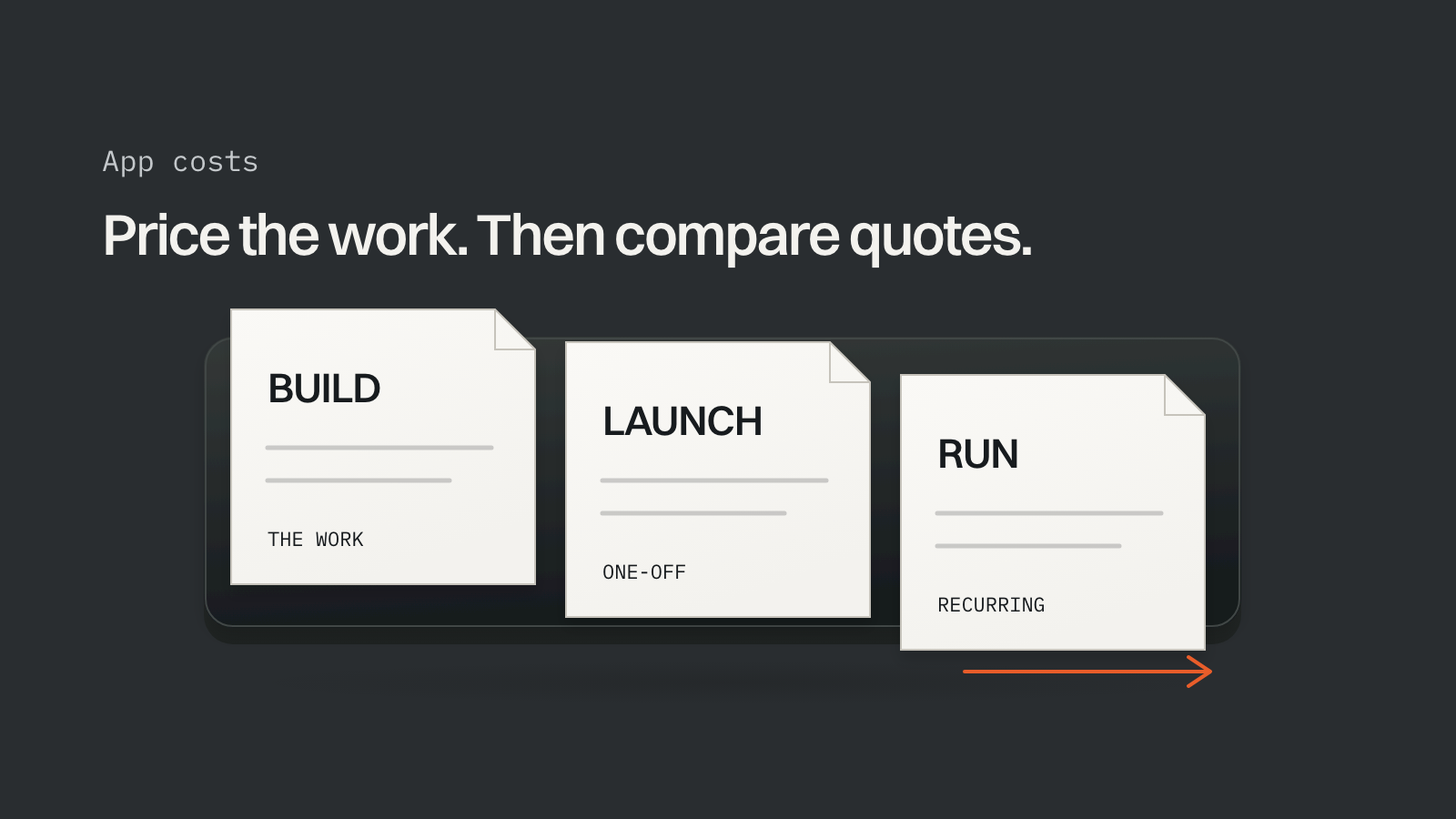
There isn't a defensible single price for app development in India without a scope. A useful budget combines three things: the work to build the product, the work to verify and launch it, and the cost of operating it. Ask for them separately so you can see what changes the total.
Write down what "app" means for your business#
A public business website, a browser-based staff portal and a mobile app distributed through app stores have different jobs. Choose the format by the workflow people need to complete:
- If a customer needs to find your services and send an enquiry, a well-made website may cover it.
- If staff need permissions, assignment rules and reports, you're describing an operational system.
- If users need dependable device features or app-store distribution, say so explicitly in the brief.
The number of screens won't tell you the whole cost. A refund screen may look simple while requiring payment verification, permission checks and reconciliation. A long information page can involve less engineering.
Describe one complete journey instead. A customer picks a slot, pays, receives confirmation and later asks to reschedule. Add what staff must do at each point. That gives a supplier enough detail to find missing rules before pricing the job.
Example budget for a business website#
Assume a website with five public pages, one reusable service-page layout, an enquiry form and a content editor. The business supplies approved copy and photographs. There are no customer accounts, payments, multilingual pages or migrated data.
For arithmetic only, assume an effective delivery rate of $16 an hour. Replace it with the supplier's rate or fixed-price allocation.
| Work in this example | Assumed hours | Cost at the assumed rate |
|---|---|---|
| Requirements and page structure | 12 | $192 |
| Layout and visual design | 20 | $320 |
| Page and content-editor implementation | 32 | $512 |
| Form, email routing and content entry | 12 | $192 |
| Responsive and accessibility checks | 12 | $192 |
| Launch setup and editor handover | 8 | $128 |
| Total | 96 | $1,536 |
These allocations show one possible scope; they don't predict yours. Reusing an approved template can change the design and build work. Commissioned copy, translated pages or a complex CRM connection would add work this example excludes.
The total also excludes hosting, domains, ongoing support and applicable taxes. A quote should say whether those sit elsewhere. If a supplier includes them, ask for the renewal terms and who owns the accounts.
Example budget for a booking web app#
Now assume a responsive web app with customer sign-in, a fixed booking workflow, one payment gateway and a staff dashboard, including cancellation rules and payment reconciliation. It excludes native mobile apps, video calls, marketplace payouts, complex subscriptions and imported historical records. Same assumed rate.
| Work in this example | Assumed hours | Cost at the assumed rate |
|---|---|---|
| Workflow, rules and acceptance criteria | 24 | $384 |
| Interface design | 40 | $640 |
| Data model, authentication and access rules | 56 | $896 |
| Customer bookings and staff operations | 96 | $1,536 |
| Payment verification and reconciliation | 40 | $640 |
| Functional, permission and recovery checks | 40 | $640 |
| Deployment, documentation and handover | 24 | $384 |
| Total | 320 | $5,120 |
For this exercise, reserve another 32 hours for unresolved requirements. That arbitrary 10% reserve adds $512 and brings the build allowance to $5,632. It isn't a recommended percentage for every project. A poorly understood external integration needs investigating before anyone estimates it.
A fixed-price proposal may package this work differently. The point is to see what the supplier has allowed for. If payment recovery or staff support tools are missing, decide whether that exclusion fits your business before accepting the total.
The requirements that change an estimate#
- User roles. A customer, a branch manager and a central administrator may have different permissions. Those rules affect the database and every private action.
- Integrations. Confirm API access, subscription requirements, limits and test credentials. "Connect our CRM" can mean a supported one-way export or a two-way sync with conflict resolution, and they take different work.
- Data migration. Share a sample of the source data. Duplicate contacts, missing IDs and inconsistent dates affect the effort. A supplier estimating a migration without seeing a sample should flag that uncertainty.
- Offline use, languages and device features. "Works on mobile" may mean a responsive website. It doesn't automatically mean offline sync, push notifications or an iOS app.
- Security and accessibility. Give both acceptance criteria. Our production checklist lists permission, payment and recovery checks you can ask a supplier to demonstrate.
For timing rather than money, how long it takes to build a mobile app covers how scope drives the schedule.
Add recurring and usage-based costs#
Building the app is one budget. Running it is another. These vendor fees were checked on 4 October 2026; they aren't the full cost of operating a product.
| Service | Published fee | What to check |
|---|---|---|
| Apple Developer Program | US$99 per membership year | Apple says regional prices may differ and appear in local currency during enrolment |
| Google Play developer registration | US$25, one time | Account verification and publishing requirements still apply |
| Supabase Pro | From US$25 a month | Extra projects, compute, usage and add-ons change the bill |
Keep foreign-currency costs in their billed currency until you choose an exchange-rate and tax assumption. Don't lock today's exchange rate into a fixed cost for the life of your app.
Other running costs may include hosting, storage, email, SMS, WhatsApp, maps, monitoring and AI API calls. For each, write down the billing unit and expected monthly volume. Ask who receives alerts and what happens when you exceed a quota.
Maintenance needs its own definition too: response time, supported services and included work. Bug fixes, dependency updates, content changes and new features aren't interchangeable, and a monthly retainer is hard to compare until you know which of them it covers.
Model payment fees from your own sales#
Razorpay's published pricing explainer lists most domestic payments at 2% plus 18% GST on the fee. Payment method, negotiated terms and offers change what applies, so confirm your account's schedule before budgeting.
For a business taking 1,000 payments of $10 a month, with every payment attracting that 2% fee:

- Processed each month
- $10,000
- Gateway fee at 2%
- $200
- GST at 18% of the fee
- $36
- Monthly charge
- $236Simplified example
The calculation ignores method-specific rates, offers and your business's tax treatment; ask your accountant about the invoices. Transaction costs can change the running budget more than an app-store fee, so show the volume assumption beside the number.
Look at the first year before approving the build#
Return to the booking app. Its build allowance was $5,632 including the reserve. Add four maintenance hours a month at the same rate, plus an invented $30 monthly allowance for infrastructure and messages:
| Component | Example amount |
|---|---|
| Build and reserve | $5,632 |
| Maintenance, 4 hours × $16 × 12 months | $768 |
| Infrastructure and messages, $30 × 12 | $360 |
| First-year total, before the exclusions below | $6,760 |
The $30 figure is a placeholder for a service-by-service forecast. The example excludes taxes, payment fees, marketing, staff time and new features; it is a web app, so app-store fees aren't in scope.
A first-year view exposes an easy mistake. A lower build price may come with a required subscription or paid support arrangement. Add those contractual costs before comparing suppliers.
Compare proposals against the same brief#
Give every supplier the same workflow, roles, integrations and acceptance criteria, and ask each to list assumptions and exclusions. Then:
- Check ownership of the repository, database, domain and vendor accounts, and whether the handover includes setup instructions and a usable export of your data.
- Tie payment milestones to things you can review. A prototype, a working end-to-end workflow and an accepted handover are easier to judge than "development 80% complete".
- Agree how new requests change scope and price before they arrive.
If a ready-made platform covers the essential workflow, compare its subscription, limits and exit costs with a custom build. Our coaching platform versus custom app guide works through one concrete case.
Bring us your main workflow, required integrations and a budget ceiling through the FAQs and contact options. We'll discuss a first scope and what to leave for later. The most useful starting point is what your customer and your team must be able to do when the first version ships.
Sources#
- Apple, Developer Program enrolment, for membership cost and regional pricing.
- Google, Play Console registration, for the one-time developer fee.
- Supabase, pricing, for plan starting prices and usage costs.
- Razorpay, payment gateway pricing explainer, for the domestic-payment example.